
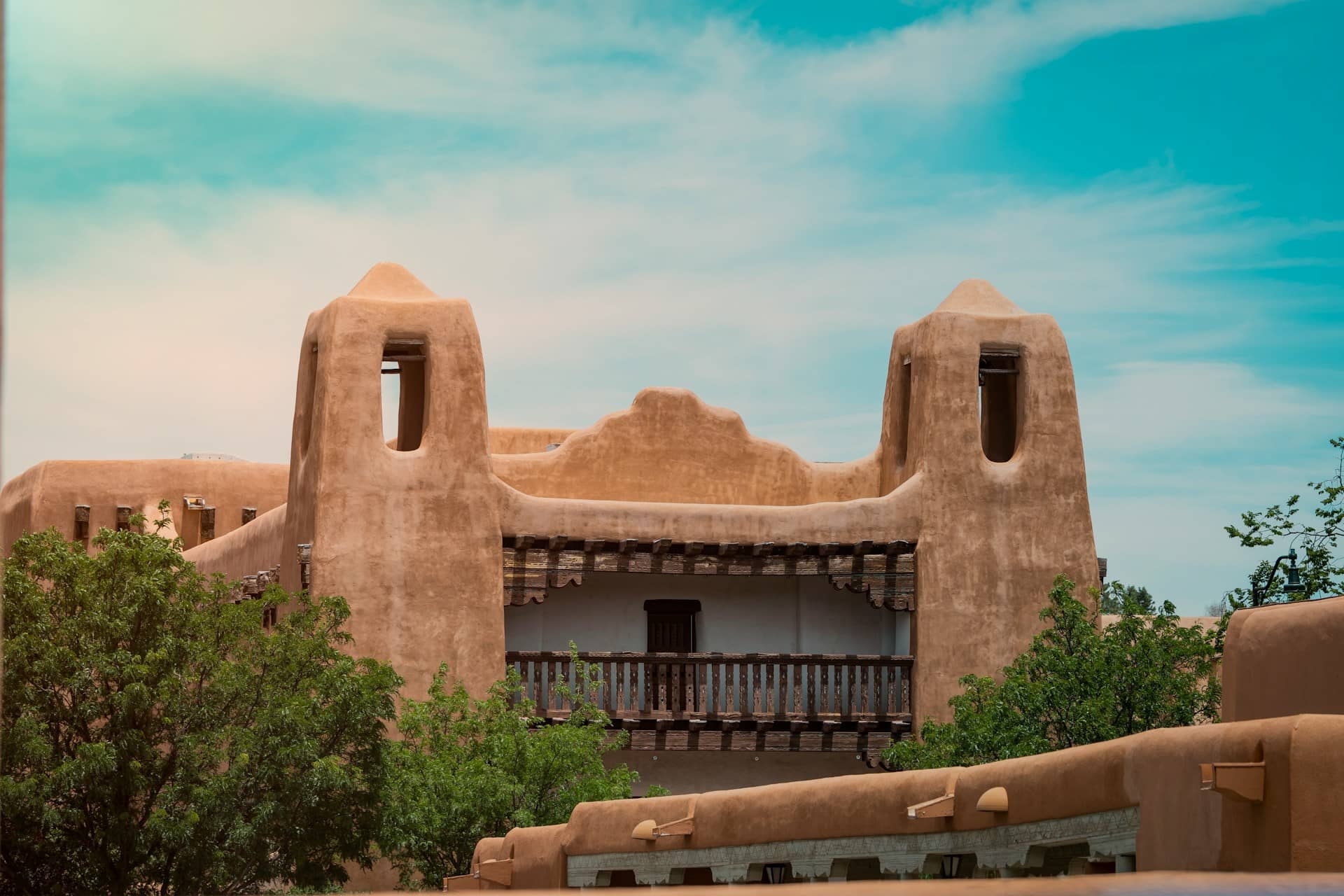
Looking for a Santa Fe itinerary? This three-day guide covers the best things to do in Santa Fe, memorable local food spots, historic landmarks, and scenic experiences across New Mexico’s high desert landscape.
The first evening in Santa Fe hits differently. One glance at the adobe-lined streets beneath the Sangre de Cristo Mountains and you already know a quick stop will never feel like enough. At 7,000 feet above sea level, the city carries crisp air, earthy colors, and sunsets that glow across clay-toned buildings long after dusk settles in.
Spend two days here and Santa Fe starts pulling you deeper into its rhythm. You begin craving smoky green chile enchiladas, fresh sopapillas drizzled with honey, and icy margaritas after long walks through galleries and old plazas. Every corner feels layered with history, art, and quiet desert charm that lingers well beyond the moment.
Three days in Santa Fe gives you room to slow down and actually absorb the atmosphere. Mornings start with coffee and mountain air, afternoons drift through museums and canyon roads, and evenings stretch into colorful skies over Northern New Mexico. By the third day, you’re ready for scenic drives, roadside stops, and a wider look at the dramatic terrain surrounding the city.
So if you only have 72 hours in “The City Different,” this Santa Fe itinerary will help you make the most of every hour while soaking in the food, culture, art, and rugged scenery that make New Mexico’s capital unforgettable.
Day One: Exploring Santa Fe
9:30 AM – Downtown Santa Fe
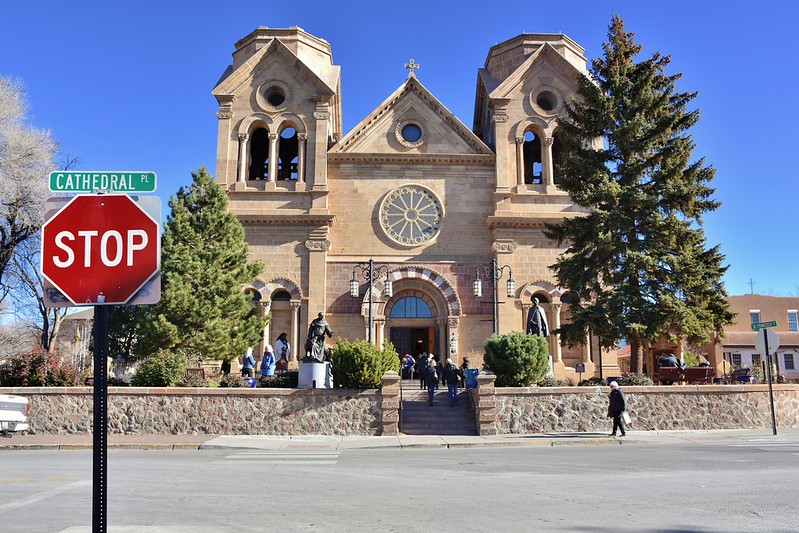
I spot Cathedral Basilica of St. Francis of Assisi while walking up E San Francisco Street. The sidewalk shifts constantly beneath my feet, changing from brick to concrete as the road tilts ever so slightly uphill. Santa Fe streets rarely follow a perfect line, yet the cathedral remains fixed ahead, rising above the adobe-colored buildings surrounding it.
Morning light slips through the cathedral’s twin towers, one standing only a little taller than the other. The pale Romanesque structure feels enormous compared to the low rooftops nearby. Its stone exterior catches the cold mountain air differently, glowing softly against the muted browns and dusty reds of downtown Santa Fe.
A thin cloud of frost leaves my breath as I climb the small staircase leading to the church entrance. A few other visitors gather nearby, waiting for local historian Ana Pacheco. Her family arrived in Santa Fe in 1692, nearly two hundred years before the cathedral itself was completed. Aside from a short chapter in New York, she has spent most of her life here and carries decades of Santa Fe history with her.
For years, Pacheco ran a quarterly publication centered on New Mexican history. She collected oral stories from longtime residents and wrote several books focused on Santa Fe and the surrounding state. Her tours fill quickly, and after hearing about her reputation, I understood why people reserve spots weeks ahead of time.
At 9:50 AM, she arrives carrying a large black binder stuffed with historic photographs. She speaks with the calm certainty of someone who has spent years studying the city’s contradictions, triumphs, and scars. Throughout the walk, she holds old photos beside present-day buildings, letting the past and present stand face-to-face on the same street corners.
As we move through downtown, Pacheco points out traces of Moorish architecture woven into Santa Fe’s design. She gestures toward a crowded chocolate shop and explains that the building once served as a checkpoint connected to the Manhattan Project. She breaks down the long path New Mexico took before becoming a state and shares the meaning behind the red Zia sun symbol stamped across the state flag.
What makes the tour memorable is how personal it feels. These landmarks are tied directly to her own life — the schools she attended, the churches she visited, the streets she crossed growing up. Santa Fe is more than a topic she teaches; it is part of her identity, and she welcomes visitors into that story.
If you cannot join one of Pacheco’s tours, I still recommend spending the first few hours of your Santa Fe itinerary wandering downtown on foot. The streets alone tell plenty of stories.
Downtown Santa Fe Guide
Here are a few worthwhile stops to include while wandering through downtown Santa Fe on foot:
- Georgia O’Keeffe Museum: One of the city’s most visited museums, featuring paintings and exhibitions dedicated to the life and work of legendary artist Georgia O’Keeffe.
- Palace of the Governors: Handmade silver jewelry, pottery, and artwork line the historic portal daily from 8:30 AM to 5 PM. Through the long-running Portal Program, Native artists sell directly to visitors, making this one of the best places in Santa Fe to support Indigenous artisans.
- Santa Fe Plaza: This central gathering space features grassy lawns, shaded benches, and intersecting walkways surrounded by cafés, shops, galleries, and street vendors.
- IAIA Museum of Contemporary Native Arts: Often called MoCNA, this museum focuses entirely on contemporary Native art and artists. Admission is free every Friday.
- La Fonda on the Plaza: Guided hotel tours run Wednesday through Saturday inside this nearly century-old landmark property. Tours begin around 10:30 AM and are free, though reservations are required by phone.
- San Miguel Chapel: Widely recognized as one of the oldest churches in the United States, this small adobe chapel carries centuries of local history within its walls.
- New Mexico State Capitol: Better known as the Roundhouse, the capitol building doubles as an impressive public art space filled with paintings, sculptures, and mixed-media works from New Mexico artists.
- Burro Alley: This narrow brick pathway traces part of Santa Fe’s early trading history. In the 1600s, burros carried firewood through this route into town. Today, it serves as a pedestrian shortcut between W San Francisco Street and Grant Avenue.
- Georgia O’Keeffe Museum: One of the city’s most visited museums, featuring paintings and exhibitions dedicated to the life and work of legendary artist Georgia O’Keeffe.
1:00 pm Georgia O’Keeffe Museum
As I make my way from Old Santa Fe Trail toward Georgia O’Keeffe Museum, downtown Santa Fe feels fully awake. Red chile ristras sway beneath the sharp afternoon light while restaurant doors swing open and release the smell of tortillas, roasted peppers, and sizzling meat onto the sidewalks. Visitors drift between weathered adobe buildings, upscale galleries, and small boutiques packed tightly along the streets.
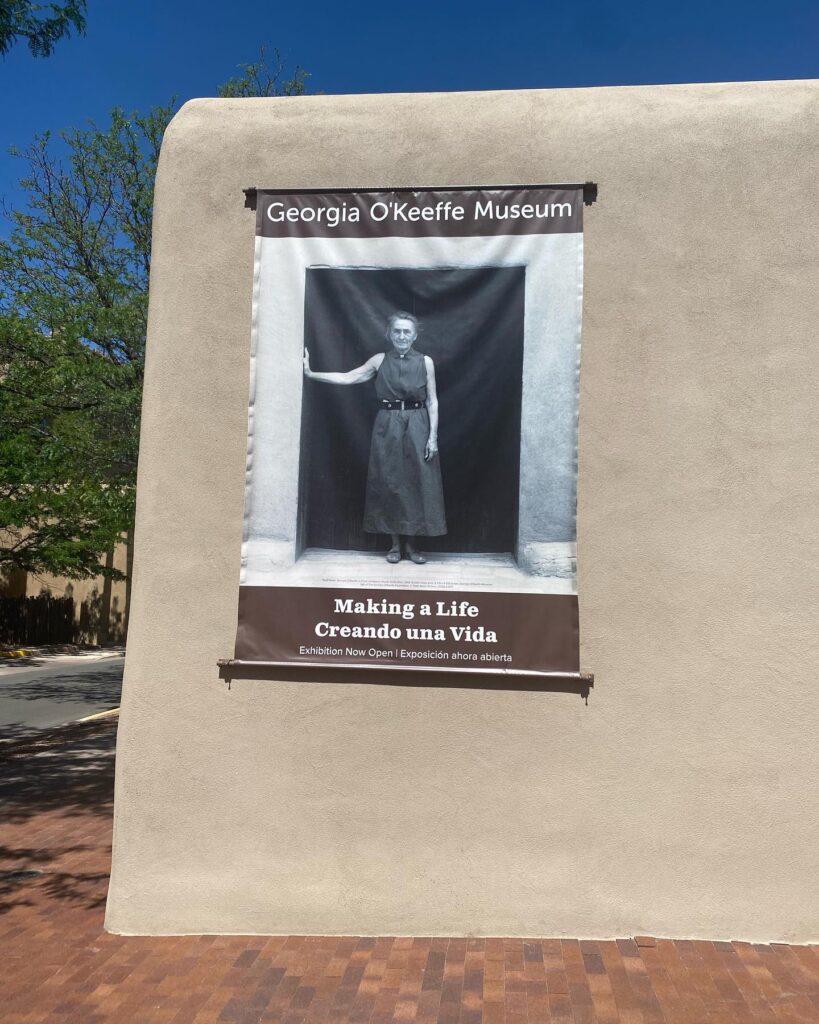
A few blocks later, I spot the familiar face stretched across the museum exterior — soft eyes, quiet smile, silver hair. Georgia O’Keeffe still feels larger than life here. Few artists remain so closely tied to New Mexico’s deserts, mountains, and empty spaces.
Crowds gather both outside and inside the museum, and it quickly becomes obvious why booking ahead matters. Same-day tickets can disappear early, and walk-in visitors often wait hours for the next available timed entry. Reservations are the easiest way in. Entry slots run every fifteen minutes, but once inside, visitors can move through the galleries at their own pace.
I settle in slowly, slipping headphones on for the audio tour while wandering through the white-walled rooms. The museum feels calm and stripped back, letting the artwork carry the atmosphere without distraction. While a handful of O’Keeffe’s famous flower paintings appear throughout the collection, I find myself pulled more toward her New Mexico landscapes — dry hills, dark cliffs, pale skies, and desert tones painted with quiet intensity.
The exhibition spaces focus heavily on her connection to the American Southwest. Many of the works feel almost meditative, capturing empty terrain with surprising emotion. The soft pastels and fading earth colors mirror the same scenery visible outside the museum doors.
One of the strongest sections is Making A Life, an exhibition exploring O’Keeffe’s creative routines, inspirations, and years spent in New Mexico. Old photographs, personal items, and sketches help piece together the life behind the paintings. Afterward, the rotating exhibition offers a different perspective on her work, often centered around themes, periods, or artistic influences connected to her long career.
4:00 PM – Tumbleroot Pottery
During spring and summer, Santa Fe evenings stretch slowly across the sky. Blue fades gradually into dark violet while the sun lingers behind the mountains a little longer than expected. It feels like the city quietly pushes back against rigid schedules, reminding visitors to stop rushing from one attraction to the next.
I tend to pack my Santa Fe days too tightly, but this city rarely rewards speed. Restaurants fill naturally, galleries invite long pauses, and conversations drift without urgency. After a while, I stop checking the time and settle onto a barstool inside Tumbleroot Pottery Pub instead.
At a communal table, I press my fingers into a pound of cool gray clay dropped into a metal tray. For a moment, I honestly have no idea what I’m doing. My knees tap awkwardly against the counter while I flatten the clay onto a spinning disk using my palms and a small spatula.
Nearby, a husband proudly lifts a rolled strip of leftover clay. “Look, I made a snake,” he jokes to his wife while she keeps shaping a Southwestern-style pot beside him. Across the room, another visitor carefully carves twisted tree trunks inspired by paintings from Georgia O’Keeffe. Around us sit half-finished clay chiles, crosses, bowls, and tiny desert cacti drying beneath the warm indoor lights.
Hours slip by quietly. Tools move back and forth across the tables — brushes, stamps, carving knives, wooden mallets. Most people stay focused on their projects, occasionally laughing at cracked handles or lopsided bowls. When newcomers walk in, they usually ask if everyone here is local. Nearly every table shakes their head no.
Tumbleroot clearly attracts travelers, yet it avoids feeling overly polished. The pottery studio sits downtown on a busy corner, easy to stumble into while wandering Santa Fe. There’s a bar serving beer in handmade ceramic mugs crafted by local artists, and visitors are free to sip while working on their clay pieces. Shelves nearby display glazed bowls, mezcal cups, and other handmade pottery from Santa Fe creators.
The process itself stays refreshingly simple. Each guest receives a pound of self-drying clay, a beginner instruction sheet, and access to all the tools needed for shaping and painting. Spray bottles keep the clay damp, wires slice slabs cleanly, and tempera paints wait for finishing touches. Boxes are even available for carrying projects home afterward.
What I end up loving most is the atmosphere. It feels social without demanding conversation. People settle into their own little creative worlds, quietly turning memories of Santa Fe into bookends, dishes, jewelry holders, and strange clay experiments that somehow still feel worth keeping.
Artist’s Track, Day Two: Santa Fe Guide
10:00 AM – The Railyard
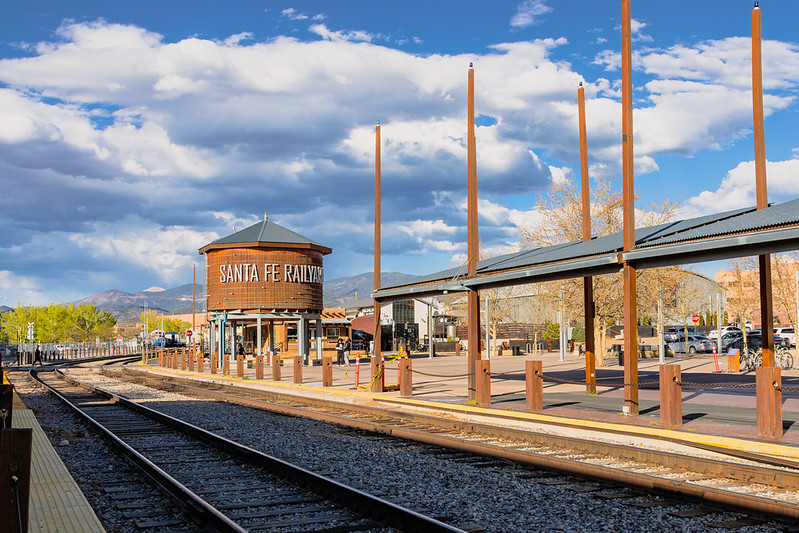
I’m reminded how spacious Santa Fe feels when I arrive at Santa Fe Railyard. People drift between long rows of buildings separated by enough space for train tracks to slice directly through the middle. The district feels open and airy, almost stretched beneath the New Mexico sky.
The first train rolled into Santa Fe near the end of the nineteenth century, changing the city permanently. Wagons and dusty trade routes slowly gave way to rail travel, bringing visitors, workers, and business into The City Different. Neighborhoods expanded outward from the station, and the rail corridor became a gathering place tied closely to Santa Fe’s growth. Later, as interstate highways took over long-distance travel, the station gradually lost much of its earlier energy.
Everything shifted again in 2008 when the district was reworked into the modern commercial and cultural hub it is today. Outside the renovated depot, the New Mexico Rail Runner Express still arrives daily from Albuquerque. Before the train even appears, its wheels groan loudly against the tracks, sounding oddly similar to a heavy washing machine beginning its cycle.
I settle onto the patio at Sky Coffee with a cappuccino warming my hands against the chilly air. People cross back and forth over the tracks while traffic rolls steadily along Alcaldesa Street nearby. Eight years after my last visit, Violet Crown Cinema still catches my attention first. The building’s dark brown exterior almost resembles a giant chocolate bar peeled halfway open. Inside, the theater feels more worn than I remembered, though locals still clearly love it for its indie films and smaller screenings.
Once I finish my coffee, I wander into the Santa Fe Farmers’ Market. Saturdays here overflow with vegetables in strange shapes and bold colors — purple cauliflower, oversized carrots, piles of turnips stacked across crowded tables. Nearby, the smell of butter, garlic, and fresh bread drifts through the market aisles. I pull apart a warm piece of flatbread streaked with green chile and instantly regret not buying more.
Travelers should carry a little cash while visiting the market. Several vendors, including smaller food stalls, still operate cash-only. There is an ATM outside the market building if needed, but having small bills ready makes things easier.
As spring rolls into summer, the market expands outdoors along the rail platform. Tuesday markets run from May through December, while Sundays shift focus toward handmade goods and local artists during the Artisan Market.
Across the street sits SITE Santa Fe, one of the city’s most interesting contemporary art spaces. The galleries constantly transform between exhibitions. Walls disappear, layouts change, and each installation reshapes the building entirely. The museum pushes visitors to look at modern art differently, often blending abstract ideas with recognizable themes.
An attendant hands me a pamphlet while discussing artist Arturo Herrera. “He’s a little obsessed with Disney,” she says, encouraging me to stare longer at the work. Gradually, familiar cartoon shapes begin surfacing from the layered colors and splattered forms.
Other exhibits leave similar impressions. Pieces by Carmen Herrera, painted late in her life, spark thoughts about aging, recognition, and artistic value. Erin Shirreff’s Folded Stone plays with memory and perception, making ordinary objects feel strangely uncertain.
What stands out most is how approachable the space feels. Nothing about SITE Santa Fe comes across as stiff or intimidating. Gallery guides answer questions openly, helping visitors connect with the art without making anyone feel out of place.
Read more : 15 Top-Rated Things to Do in Santa Fe, New Mexico This Year
1:00 PM – Canyon Road
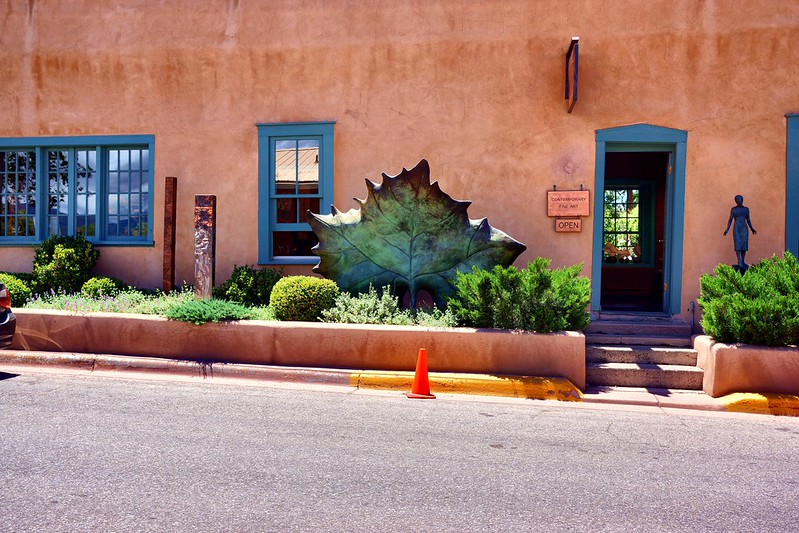
Elaine Ritchel approaches Canyon Road almost like a contemporary museum curator. Through Santa Fe Art Tours, she helps visitors feel more comfortable stepping into Santa Fe’s gallery scene, breaking down what can otherwise feel intimidating at first glance.
I make a point to visit Canyon Road nearly every time I return to Santa Fe. I’ve walked the road during winter storms while snow balanced on outdoor sculptures and adobe rooftops. I’ve wandered here in spring while birds rested along wooden beams overhead. Summer visits feel entirely different again, with dry heat radiating from the sidewalks and sunlight glowing against faded turquoise doors and old carved entrances leading into galleries.
Santa Fe ranks among the largest art markets in the United States, behind only New York and San Francisco. Canyon Road makes that reputation impossible to ignore. More than eighty galleries line the narrow historic street, packed closely together behind adobe walls, hidden courtyards, and quiet gardens.
The sheer number of galleries can feel dizzying. One cluster leads directly into another, and then another after that. Small studios branch off into side patios while larger exhibition spaces disappear behind wooden gates. Everything remains walkable, yet the amount of art concentrated into a single stretch of road can quickly blur together.
That’s where Ritchel’s tours help. Instead of trying to see everything, she carefully narrows the experience down to a manageable handful of galleries. Her approach gives visitors room to slow down and actually connect with the artwork instead of rushing through doorway after doorway.
As the tour moves along Canyon Road, conversations shift naturally between painting styles, artist backgrounds, and personal reactions. Ritchel keeps things relaxed and approachable, encouraging people to trust their own responses to the art rather than worrying about saying the “right” thing.
Even without a guided tour, Canyon Road remains one of the best places in Santa Fe for an afternoon walk. Some of the best moments happen accidentally — stepping into a quiet sculpture garden, hearing floorboards creak beneath your feet, or stumbling across a gallery hidden behind an unmarked courtyard.
A short walk away, Kakawa Chocolate House makes an excellent stop afterward. The shop specializes in rich drinking chocolates inspired by historic Mesoamerican recipes. Their hot chocolate flight lets visitors sample several flavors side by side, making it an easy favorite after hours spent wandering Canyon Road.
4:00 PM — House Of Eternal Return

Nothing really prepares you for House of Eternal Return. The experience feels like stepping directly into someone else’s dream — or maybe their strange late-night nightmare. Probably both at once. Built by Meow Wolf alongside more than one hundred local artists, the installation turns an ordinary-looking house into a maze of hidden passages, glowing rooms, and surreal details.
The deeper I move into the house, the stranger everything becomes. One moment I’m crawling through a washing machine, the next I’m squeezing behind a fireplace or ducking beneath a staircase that leads somewhere completely unexpected. Refrigerators swing open into secret tunnels. Closets hide glowing corridors. Tiny clues repeat throughout the rooms like fragments of a mystery that never fully explains itself.
The atmosphere constantly shifts between playful and unsettling. Neon trees pulse in dark corners while strange sounds echo through mirrored rooms and narrow hallways. Bottle caps crunch beneath my shoes. Colors flash across walls in waves of electric pinks, blues, and greens. The entire space feels intentionally overwhelming, like sensory overload transformed into interactive art.
Whether you’re spending two days in Santa Fe or a full week, this is one stop that deserves space on the itinerary. Meow Wolf Santa Fe has become one of the city’s most talked-about attractions for good reason. It encourages visitors to touch things, open doors, crawl through hidden spaces, and wander without a clear destination.
That freedom becomes part of the experience. Every closed door seems to reveal another hidden room nearby. You might stumble into a glowing forest, then suddenly find yourself standing inside a sci-fi hallway or a room filled entirely with mirrors. The installation contains more than seventy spaces, and no two visitors seem to move through them the same way.
At the same time, House of Eternal Return can feel exhausting in the best possible sense. The layout twists endlessly, pulling your attention in every direction. A quick walkthrough barely scratches the surface, but spending too many hours inside can leave your brain buzzing from the constant stimulation.
One thing worth noting: Meow Wolf recently announced major staffing cuts across the company. I visited House of Eternal Return before those layoffs happened, so it’s difficult to say whether future visits will feel any different. Still, the scale, creativity, and imagination poured into this Santa Fe installation remain hard to compare with anything else in the city.
Day 3 of Santa Fe Itinerary: Escape Day
7:00 AM Bandelier National Monument
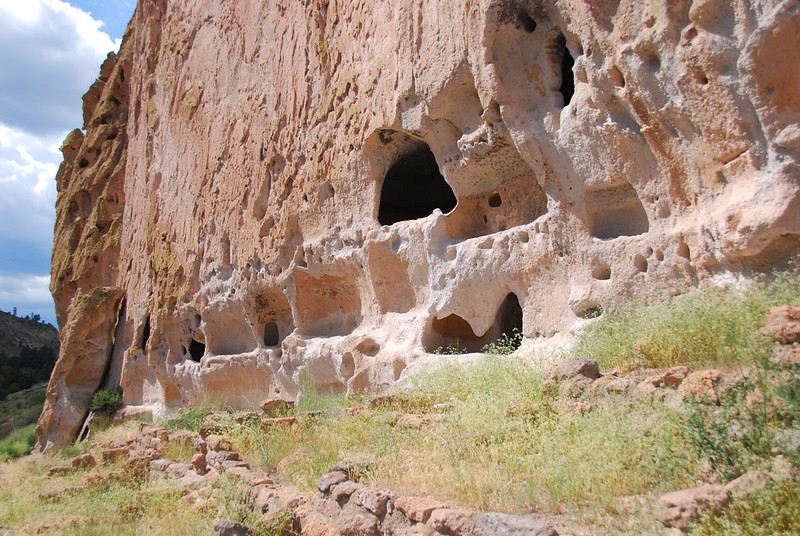
Eight years ago, I arrived at Bandelier National Monument just after 7 AM on a quiet spring morning. Near the trailhead sat a small wooden box filled with red paper maps for visitors to borrow. I grabbed one and started down the Main Pueblo Loop Trail while the sound of Frijoles Creek drifted softly through the canyon beside me.
The trail felt cool and shaded early on. Twigs cracked beneath my shoes while water slipped gently across smooth rocks nearby. As the sun climbed higher, patches of gold light spilled across the canyon walls and grassy slopes. The landscape itself tells a story stretching back over a million years, when volcanic ash blanketed this region before cooling into soft rock known as tuff.
Over time, wind and erosion carved small openings into those canyon walls. Centuries later, Ancestral Puebloans shaped many of those openings into cavates — small human-made dwellings tucked directly into the rock face. Looking up at the cliffside homes, they almost resemble stacked apartments carved into stone.
Wooden ladders still lead visitors into several of the cavates today. Climbing them can feel exciting and slightly unsettling at the same time. I only managed to enter one before my fear of heights completely took over. The narrow ladders and steep drop-offs near Alcove House triggered a full panic attack, so I stopped there instead of continuing upward. Alcove House rises about 140 feet above Frijoles Canyon, and honestly, that was enough for me.
Even without climbing higher, Bandelier leaves a strong impression. Human history here stretches back roughly 10,000 years, and the canyon carries that age visibly across every cracked rock wall and weathered pathway. The dry folds in the stone, the ancient dwellings, and the silence between the cliffs all make the monument feel deeply old in a way that’s difficult to explain fully.
Visitors planning a trip between May and October should know that seasonal shuttle buses are often required for access to the main entrance area. The free shuttle departs from the White Rock Visitor Center roughly every twenty minutes between morning and mid-afternoon, though park entrance fees still apply. America the Beautiful passes are accepted as well.
Now, nearly a decade after that first visit, I find myself driving the same road again. This time, before reaching Bandelier, I stop in Pojoaque to visit Poeh Cultural Center and Museum.
The adobe-style buildings rise softly against the sky, blending earth-colored walls with open desert light. Inside, the Nah Poeh Meng exhibition immediately stands out. Six immersive rooms combine storytelling, artwork, seasonal traditions, and Pueblo history into an experience that feels deeply personal rather than distant or academic.
Farther inside sits a quieter gallery filled with Tewa pottery displayed carefully across tiered platforms. Each piece stands fully visible, uncovered and unobstructed. The room feels almost reverent.
For years, Tewa representatives worked to bring many of these pots back home from Smithsonian National Museum of the American Indian through a long-term agreement. Now the pottery rests once again in Northern New Mexico, thousands of feet above sea level, glowing beneath the museum lights at the Poeh Cultural Center. After generations away, the pieces have finally returned home.